Night Sky
A measured 21.97 magnitudes per square arcsecond — the artificial glow just 3% above the natural background of the sky itself. At ~3,050 ft on the high desert, far from any city, the Milky Way is bright enough to cast a shadow. Thousands of stars, visible planets, and meteor showers overhead — no telescope required.
Key
subtitle = best season / timing
Galaxies & Deep Sky
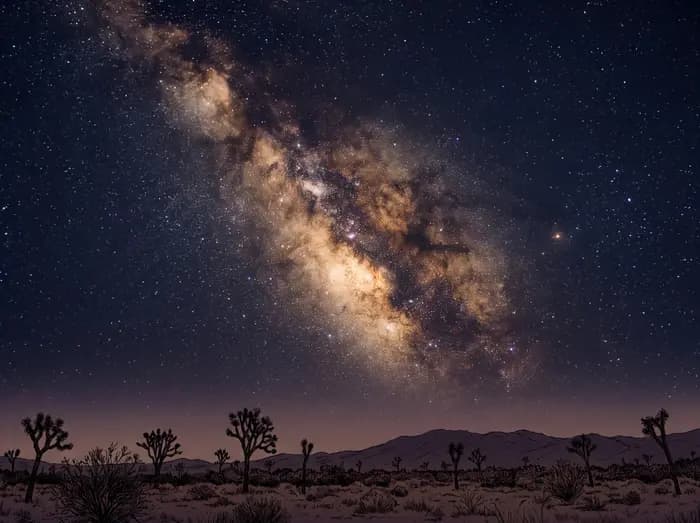
Milky Way core
Best May–September, after midnight
A pale band low in the southeast, thickened and knotted toward the galaxy's own center — tens of thousands of light-years off, erased from most modern skies but not this dark, dry one.
Read more →
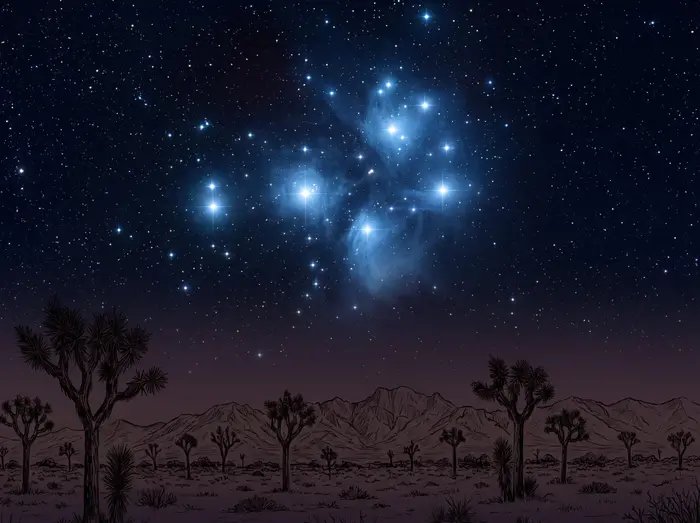
The Pleiades
Winter (M45)
Most people count six. Under a dark desert sky you may get seven, or more — and each is the bright tip of a cluster of over a thousand stars, all born together.
Read more →
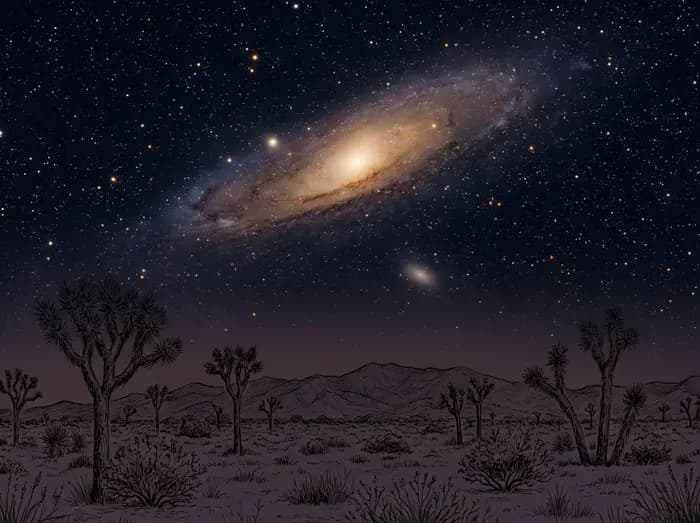
Andromeda Galaxy
Autumn (M31)
A faint autumn smudge nearly overhead is another galaxy, a trillion suns two and a half million light-years off. Look a little to the side to catch it; stare straight and it fades.
Read more →
Stars & Constellations
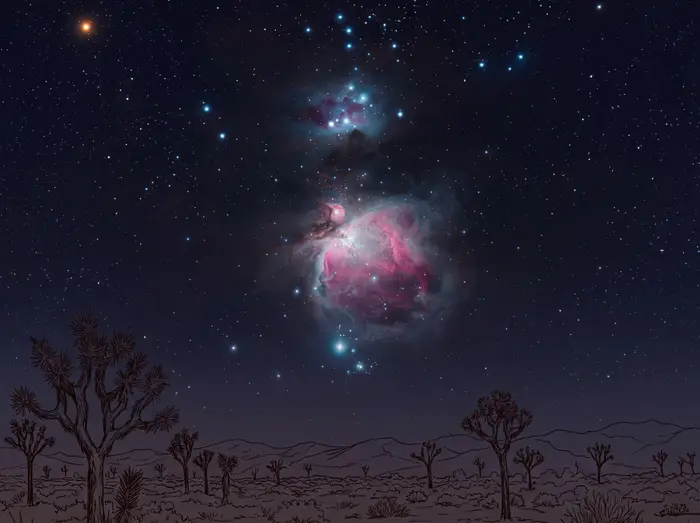
Orion & the Orion Nebula
Winter
The middle star of Orion's sword is not a star. It is a stellar nursery some thirteen hundred light-years off, fuzzy to the bare eye out here, a glowing fan in binoculars.
Read more →
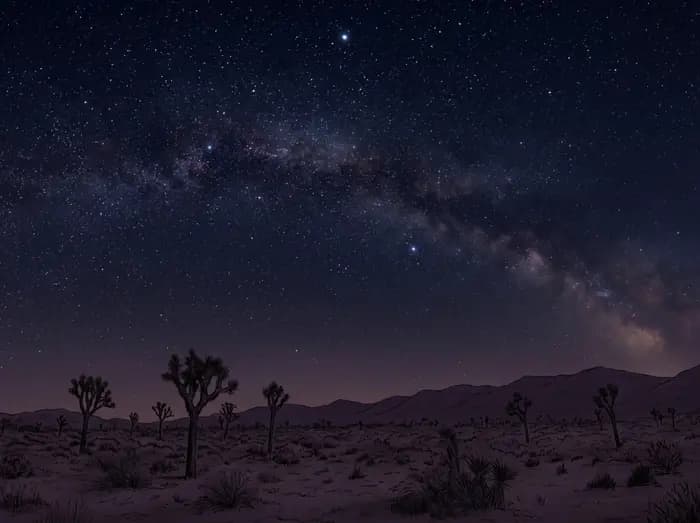
Big Dipper & Polaris
Year-round, northern sky
The North Star isn't bright — it's the one that doesn't move. Find the Dipper's two Pointers, run their line five times, and you have true north for free, no compass to correct.
Read more →
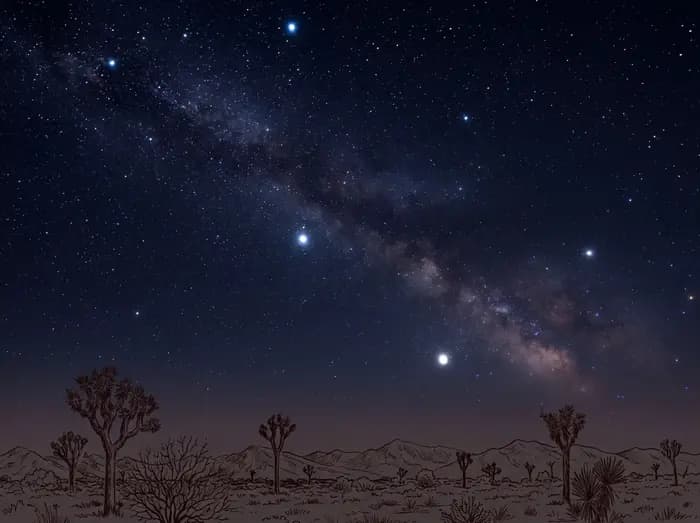
Cassiopeia
Year-round, northern sky
When the Dipper sinks low behind a ridge, the W of five stars opposite it rides high. From dark desert ground one of the pair is always up, and north lies halfway between them.
Read more →
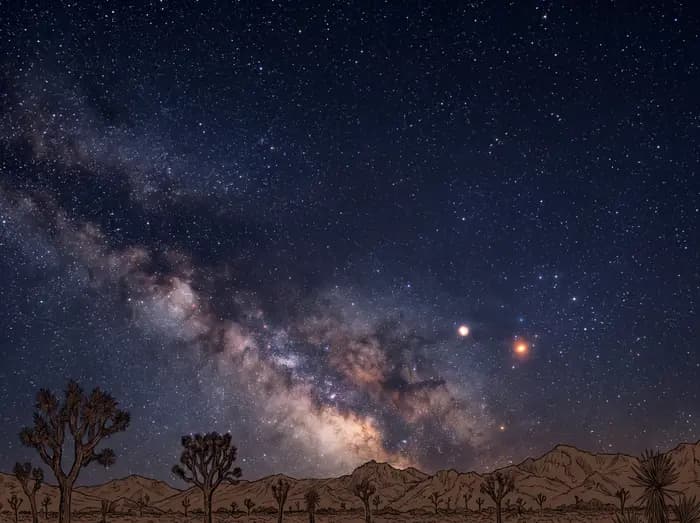
Scorpius & Antares
Summer, low in the south
The red heart of the scorpion, low in the south. Antares means "rival of Mars," and it is a dying supergiant that would swallow the inner solar system whole.
Read more →
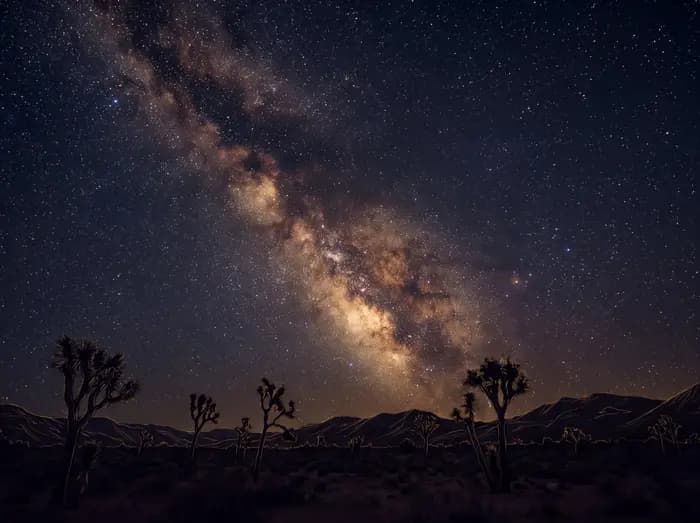
Sagittarius teapot
Summer, south
Eight stars low in the summer south make a teapot, and the steam off its spout is real: the Milky Way's core, pouring from the pot only where the sky is dark enough to show it.
Read more →
Summer Triangle
Summer, overhead
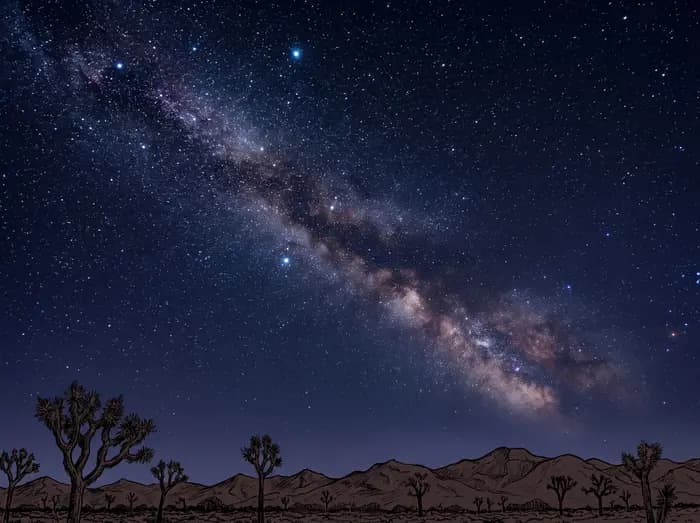
Three bright stars overhead all summer: Vega, Deneb, and Altair. Two are near neighbors; Deneb only looks their equal from somewhere past fifteen hundred light-years, a supergiant faking it.
Read more →
Winter Hexagon
Winter, overhead
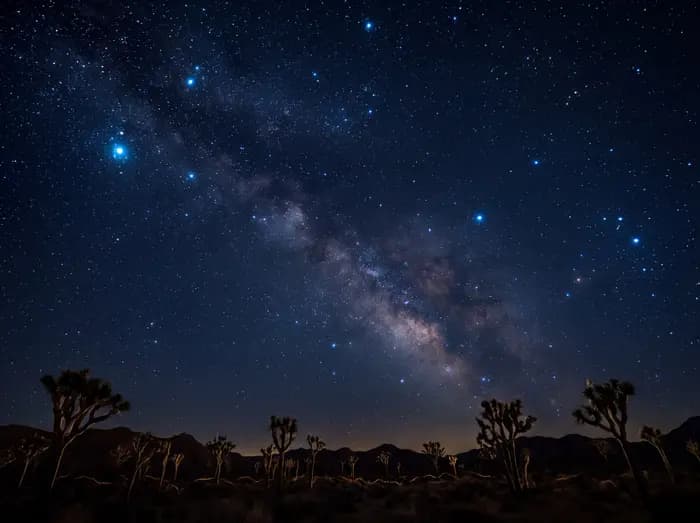
Six of the year's brightest stars ring the January sky, Orion inside. The coldest, driest desert nights are the clearest, and Sirius, lowest and brightest, flashes through every color.
Read more →
Planets
Venus
Dawn or dusk, never far from the sun
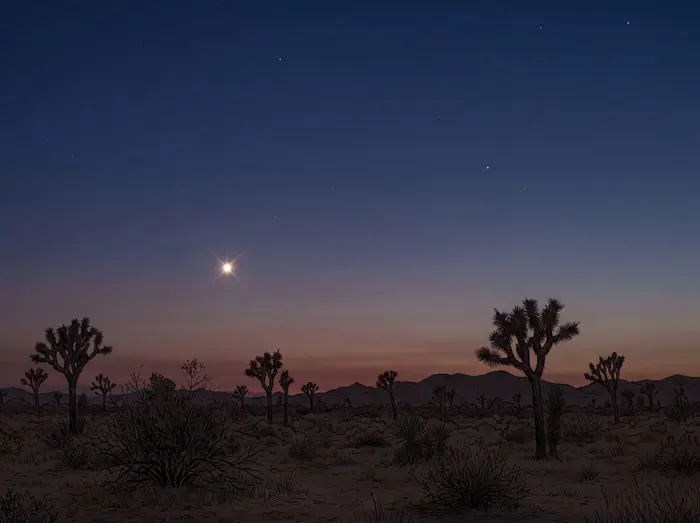
Brightest thing after the Moon, and it never climbs: Venus is chained within ~47° of the Sun, so it only hangs low at dusk or dawn. Steady where stars flicker; binoculars show its phases.
Read more →
Jupiter
Varies by year
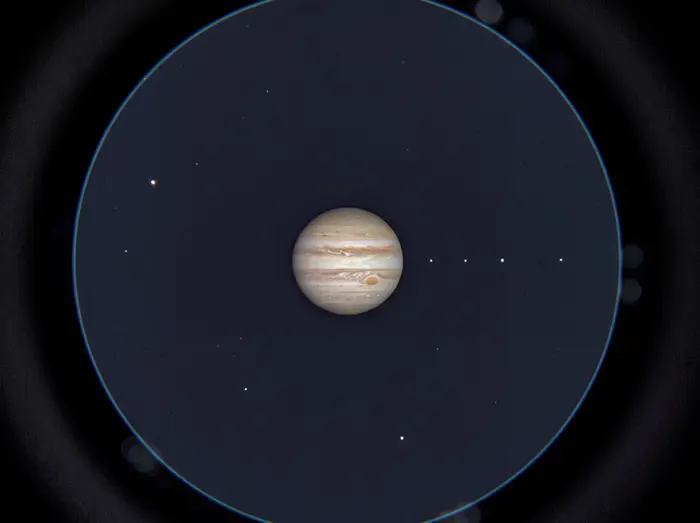
A steady point brighter than any star but Venus; brace binoculars on a post and its four moons line up as dots, the same sight that undid the Earth-centered sky in 1610.
Read more →
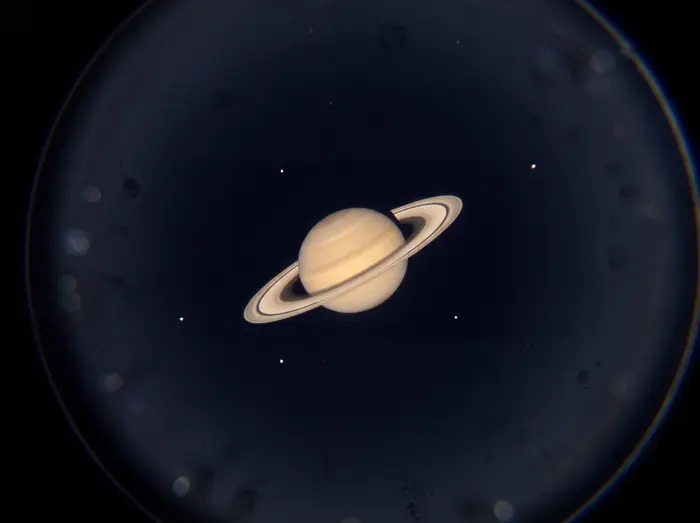
Saturn
Varies by year
To the naked eye a dull, steady, faintly yellow point that even a dark sky can't rescue. A cheap second-hand scope turns it into rings on every side, with Titan alongside.
Read more →
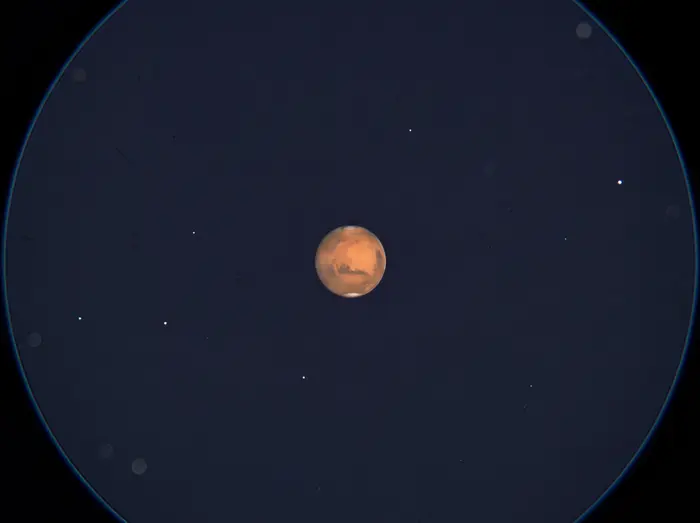
Mars
Brightest near opposition (~every 2 years)
The one planet whose colour you can name unaided: that orange is real rust, iron-oxide dust read straight off the disc. A dim dot most years; roughly every twenty-six months it flares.
Read more →
Meteor Showers
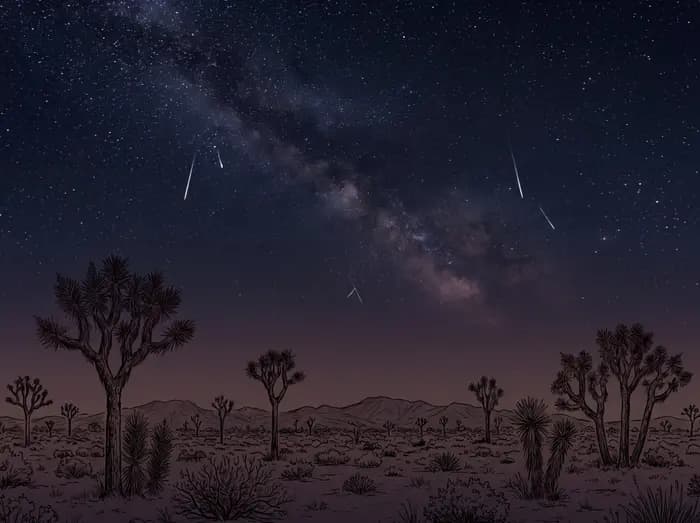
Perseids
Peak ~August 12
Sand-grain dust from Comet Swift-Tuttle, vaporising to a line of light tens of thousands of miles an hour. It peaks around the twelfth of August; sixty an hour under a dark sky, no gear needed.
Read more →
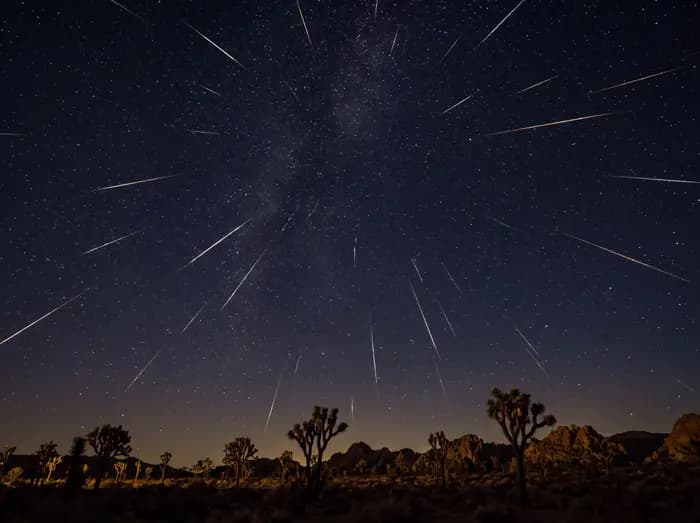
Geminids
Peak ~December 14
The best meteor shower of the year, and almost nobody watches it — it peaks in the coldest week of December. And the debris isn't a comet's at all, but a rock's: asteroid 3200 Phaethon.
Read more →
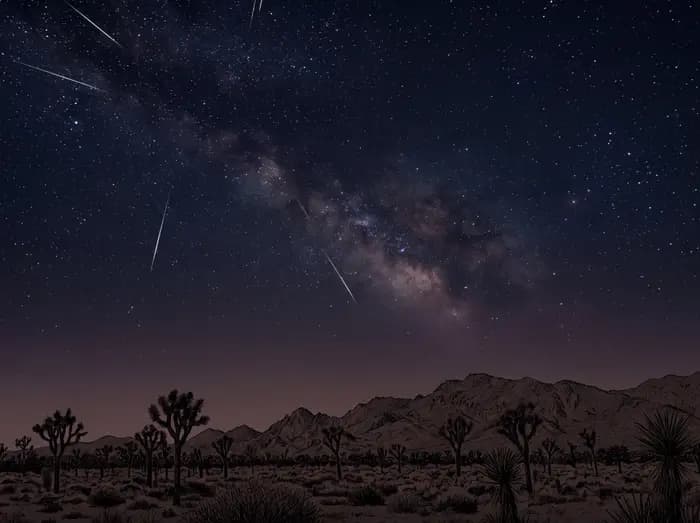
Quadrantids
Peak ~January 3
January's meteor shower, and a gamble: its peak lasts only hours, so you catch it or miss it. Its parent is not a comet but an asteroid, and its namesake constellation no longer exists.
Read more →
Sky Phenomena
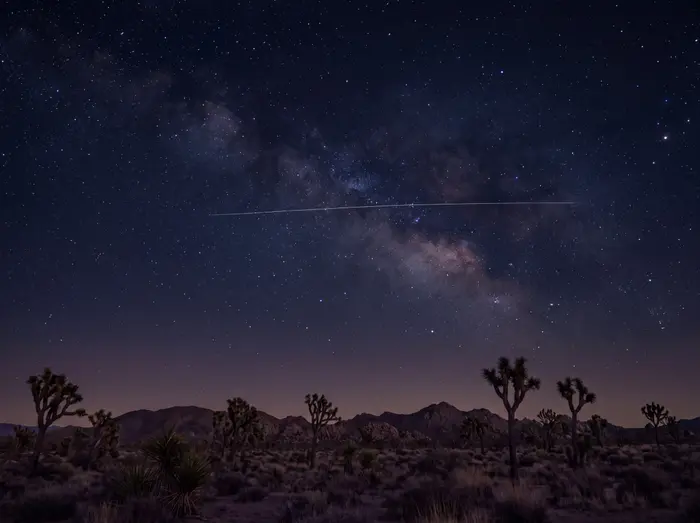
ISS pass
Predictable — check a pass app
The one light up here you can set a clock by: an app gives the minute it clears the horizon. A football-field spacecraft, crewed since 2000, that doesn't blink and fades out mid-sky.
Read more →
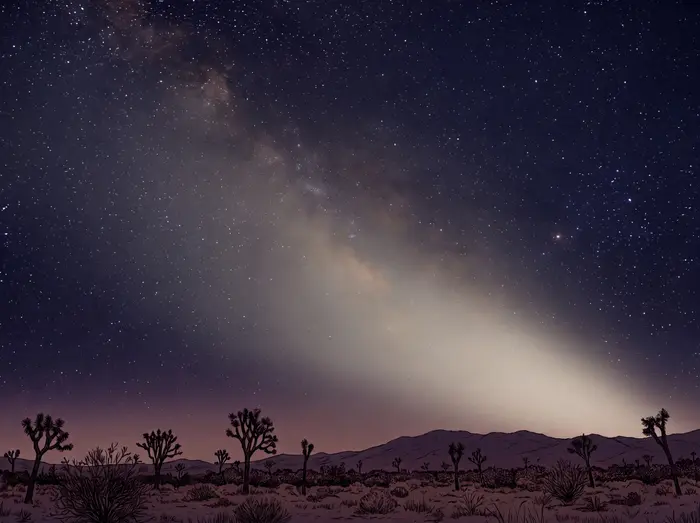
Zodiacal light
Spring evenings / fall mornings, no moon
The false dawn: a pale cone of sunlight scattered off comet dust in the solar system's plane. Fainter than the Milky Way — seeing it at all certifies a genuinely dark sky.
Read more →
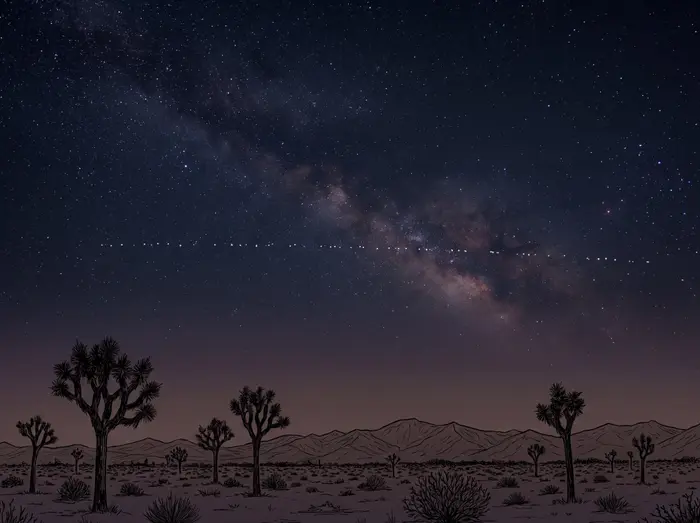
Satellites & Starlink trains
Year-round, dusk & dawn
A steady dot that never blinks and fades mid-sky is a satellite, lit by a sun already set for you. A straight string of them is a fresh Starlink train — new, and gone within weeks.
Read more →